Explain the Different Costs of a Typical Firm
The firm has to bear certain implicit costs ie. Money costs of the firm include the outlays on men materials power new machinery and so on.
2
Real and opportunity costs as well.
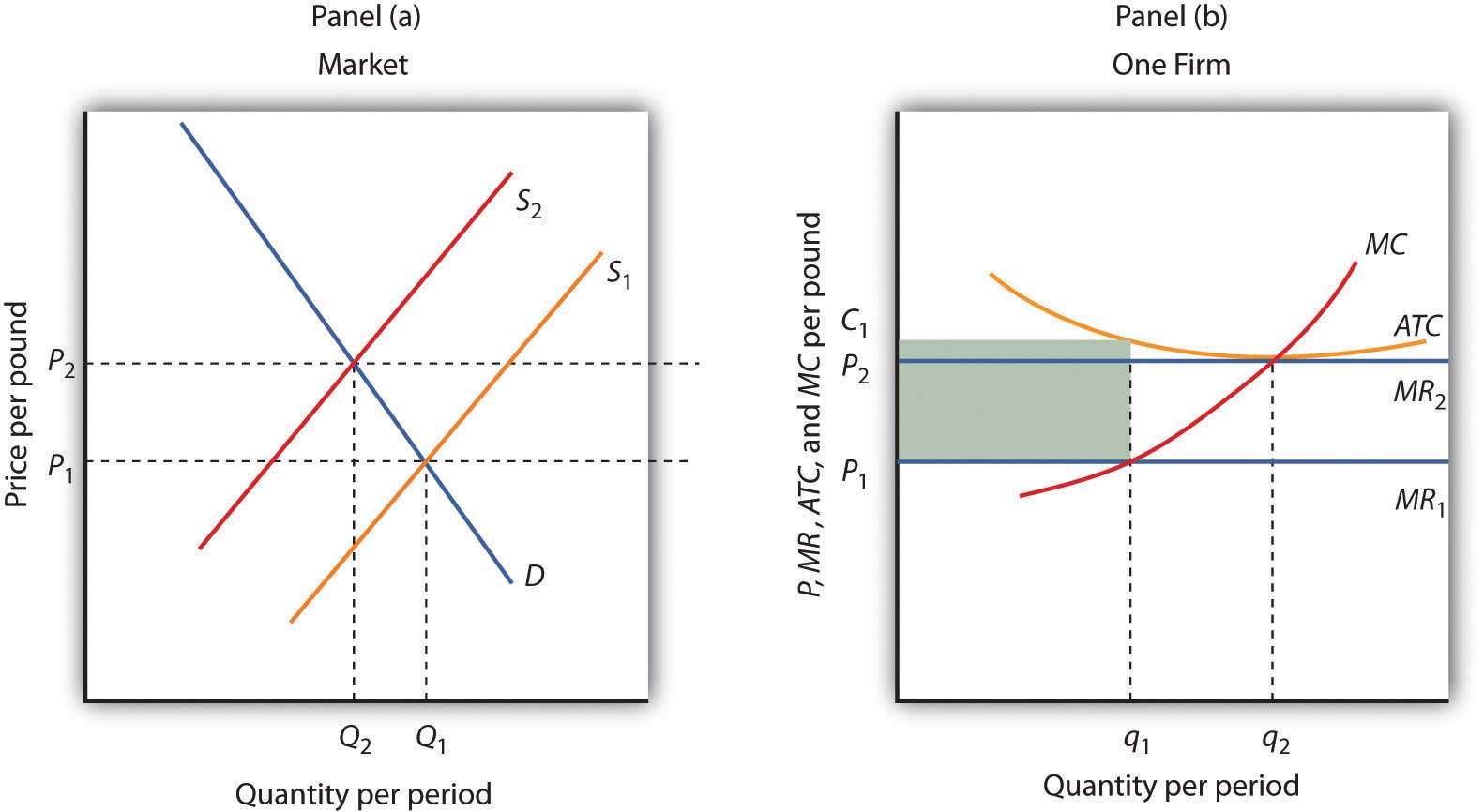
. Within these costs are other types of cost as well. In Panel a the supply curve shifts from S 1 to S 2. Costs can have different relationships to output.
These costs include payment of wages and salaries payment for raw-materials interest on borrowed capital funds rent on hired land Taxes paid etc. May be less than average total cost in which case the firm is making losses or price may be. Total Fixed Cost.
Average Variable Cost. Because each of them has shifted downward by 3 the industry supply curve shifts. Costs also are used in different business applications such as financial accounting cost accounting budgeting capital budgeting and valuation.
A pool of activity costs associated with particular processes and used in activity-based costing ABC systems. Fixed costs variable costs total costs average costs and marginal costs. A reduction in production cost shifts the firms cost curves down.
Short-run costs are the costs which vary with the variation in output the size of the firm remaining the same. For example a restaurant may regard its building as a fixed factor over a period of at least the next year. The industry supply curve is made up of the marginal cost curves of individual firms.
Our analysis of production and cost begins with a period economists call the short run. The firms average total cost and marginal cost curves shift down as shown in Panel b. In other words short-run costs are the same as variable costs.
This isnt necessarily always the case- the total cost curve could be linear in quantity for example- but is fairly typical for a firm for reasons that will be explained later. The graph above plots the long-run average costs LRAC faced by a firm against its level of output. In a Nutshell.
This is the cost of using an. Cost Behaviour of a Firm in Short Run. Williamson sees the limit on the size of the firm as being given partly by costs of delegation as a firms size increase its hierarchical bureaucracy does too and the large firms increasing inability to replicate the high-powered incentives of the residual income of an owner-entrepreneur.
These outlays may be called its money costs or explicit costs. The average variable cost per unit of output is therefore 8027 296 as reported in Table. The intercept on the vertical axis represents the firms fixed total fixed cost since this is the cost of production even when output quantity is zero.
Total Variable Cost. For each of these scales there is. These costs are measured in dollars.
To analyze and understand firms production decisions it is important to know the different types of costs they face. When the firm produces 27 units of output for example the firms variable costs from Table are 80. This is partly because it is in the nature of a large firm that its existence is more secure and less.
Total cost fixed cost and variable cost each reflect different aspects of the cost of production over the entire quantity of output being produced. Equal to average total cost in which case the. This is the operation cost of running a business combined with the cost of inputs such as raw materials labour and rent.
These are the actual or business costs that appear in the books of accounts. Based on the above short run cost function the following three basic cost concepts can be identified. Long-run costs on the other hand are the costs which are incurred on the fixed assets like plant building machinery etc.
Suppose U 1 U 2 and U 3 in Fig. When the firm expands its output from Q to Q 2 its average cost falls from C to C 1. Thus the firm can be said to experience economies of scale up to output level Q 2.
75 are three different short run average cost curves for three different scales of production. The short run in this microeconomic context is a planning period over which the managers of a firm must consider one or more of their factors of production as fixed in quantity. The weighted average cost of capital WACC represents a firms average cost of capital from all sources including common stock preferred stock bonds and other forms of debt.
For a particular level of equipment and scale the average cost of a firm is represented by a U-shaped curve. However money costs do not measure all the costs of the firm. Run price may be greater than average total cost in which case the firm is making profits price.
Average Fixed Cost. The fixed cost corresponding to 27 units of output is 100. Table reports the average variable costs average fixed costs and average total costs for the numerical example of Table.
Draw the cost curves for a typical firm. A As we know that cost of a traditional firm are divided in two parts fixed cost once incurred cannot be recovered and variable cost which is likely. In contrast marginal cost average cost and average variable cost are costs per unit.
The cost that accounts for the cost of production excluding what is covered in the fixed costs. Draw the demand curve marginal revenue curve average total cost curve and marginal-cost curve for a monopolist. Further following cost curves can be derived from these three cost concepts.
Explain how a competitive firm chooses the level of output that maximizes profit. Implicit costs are the costs of the factor units that are owned by the employer himself. At that level of output show on your graph the firms total revenue and total cost.
The fixed plus variable costs. Fixed costs are costs that.
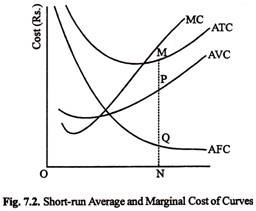
The Shape Of A Firm S Cost Curves In Long Run And Short Run
Perfect Competition In The Long Run
2
Comments
Post a Comment